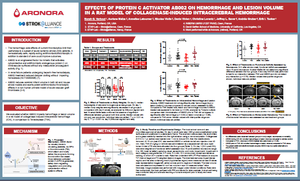
Poster dealing with Effects of Protein C activator AB002 on hemorrhage and lesion volume in a rat model of collagenase-induced intracerebral hemorrhage. The objective was to evaluate whether AB002 impacts hemorrhage or lesion volume in our rat model of ICH, in comparison to Tenecteplase (TNK). After preclinical studies conducted by our expert team, the poster concludes that AB002 maintains safety while preserving antithrombotic potential, without an increased bleeding risk. Norah G. Verbout et al. Poster presented at International Stroke Conference (ISC) by Aronora team (2026, New Orleans, USA). Poster also published in Stroke 57(Suppl_1), February 2026. | DOI: 10.1161/str.57.suppl_1.WP058.
Keywords: Hemorrhagic stroke, collagenase-induced intracerebral hemorrhage, ICH, drug development, antithrombotic therapy, bleeding risk safety
Authors: Norah G. Verbout1, Auriane Maïza 2, Annelise Letourner 2, Nicolas Violle 3, Denis Vivien 4, Christina Lorentz 1, Jeffrey L. Saver 5, András Gruber 6, Erik I. Tucker 1
Affiliated:
- 1. Aronora, Portland, OR, USA
- 2.ETAP-Lab –Strok@alliance, Caen, France
- 3. ETAP-Lab –Strok@alliance, Nancy, France
- 4. INSERM UMRS U1237 PhIND, Caen, France
- 5. David Geffen Schoolof Medicine, Universityof California, Los Angeles, CA
- 6. Work performed whileat Aronora. (retired), Portland, OR
Abstract:
The Need for Safer Thrombolytic Therapies in Acute Ischemic Stroke
Hemorrhagic risks associated with fibrinolytic drugs limit their use to a subset of acute ischemic stroke (AIS) patients. A hemostatically safe, rapidly-acting antithrombotic/thrombolytic may have broad patient eligibility and improve outcomes.
AB002 is a selective protein C activator enzyme under development for treating acute thrombotic emergencies. A proof-of-concept Phase 2 clinical study in patients with end-stage renal disease undergoing hemodialysis showed that AB002 significantly reduced dialyzer clotting without detectable hemostatic impairment (NCT03963895). In preclinical studies, AB002 reduces cerebral infarct volume in both rat and mouse stroke models and exerts potent antithrombotic/thrombolytic effects in a non-human primate model of acute vascular graft thrombosis.
Here, we evaluated whether AB002 affects hemorrhage or lesion volume in a rat model of collagenase-induced intracerebral hemorrhage (ICH), in comparison to vehicle or tenecteplase (TNK).
Experimental Design and Methods
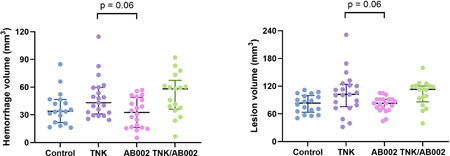
Procedures were approved by the institutional animal care and use committee. Using adult male rats (~300 g), collagenase (0.5 IU in 1 µL sterile saline) was injected over 1 min into the right striatum to induce ICH. Rats first received AB002 (15 µg/kg) or vehicle via the tail vein 15 min post-ICH, administered as bolus and infusion over 40 min. Immediately after, TNK (5 mg/kg) or vehicle was administered via a separate tail vein as a rapid bolus, generating a combination of 4 groups (n = 18/per). At 24 h post-ICH, neurological function was assessed using a 15-point scale. Rats then underwent MRI to acquire T2* (hemorrhage) and T2-weighted (lesion) images. Image analysis was performed using ImageJ by investigators blinded to treatment.
AB002 Does Not Increase Hemorrhage or Lesion Volume
AB002 treatment did not significantly alter hemorrhage or lesion volumes compared to vehicle control, assessed by MRI. Compared to TNK treated rats, lesion and hemorrhage volumes in AB002 treated rats appeared to be lower (p = 0.06). Lastly, AB002 treatment prior to TNK did not significantly alter hemorrhage or lesion volumes compared to TNK alone. No differences were observed between groups in mortality, neuroscores, or body weight.
Implications for Stroke Treatment
AB002 did not worsen hemorrhage or lesion volume in a rat model of ICH and did not impair neurological outcomes. We conclude that administration of the protein C activator AB002 before TNK thrombolysis may be reasonably safe and offer a broad therapeutic benefit in AIS and other thrombotic emergencies without an increased bleeding risk.