



Consult the scientific poster dealing with High-Throughput Brain-on-Chip Platform for Accelerating Neurodegenerative Drug Discovery, presented by Nicolas Violle for BRAINXPLORE team at the Neuroscience congress (SfN) in San Diego (United-States, November 2025). Neurodegenerative diseases such as Alzheimer’s disease are characterized by early synaptic dysfunction and neurite degeneration, long before the onset of irreversible neuronal loss. To better understand these early pathological mechanisms and improve the predictability of preclinical research, ETAP-LAB has developed a high-throughput Brain-on-Chip platform combining advanced microfluidic technologies, human iPSC-derived neurons, and high-content imaging. This innovative approach enables precise investigation of neurotoxic processes, identification of early therapeutic targets, and accelerated screening of novel drug candidates for Alzheimer’s disease and related neurodegenerative disorders. The poster presents the potential to uncover early-stage disease processes and accelerate the discovery of novel therapeutic candidates for AD and related disorders.
Related articles:
- Technical Note: High-content imaging of brain-on-chip microfluidic devices using PreciScan intelligent acquisition
- Publication on Functional discrimination of CSF from Alzheimer’s patients in a brain on chip platform
Keywords: Alzheimer’s disease; synapses; oligomers; high-throughput; Brain-on-Chip.
Authors: Nicolas VIOLLE1 , Valentin TALLANDIER1, Léane Dier1, Sonia KRIDI1, Ahmad ALLOUCHE1, Julie COLIN1
Affiliated:
- 1. ETAP-LAB, 54500, Vandœuvre-lès-Nancy, France
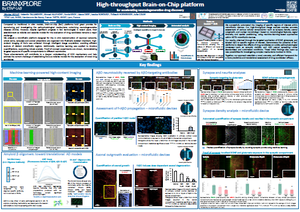
Abstract:
Background: Addressing Early Neurodegeneration and Translational Challenges in Alzheimer’s Disease
Synaptic dysfunction and loss, followed by neurite degeneration are among the earliest and most critical events in neurodegenerative diseases (NDD) such as Alzheimer’s disease (AD). These early pathological changes are strongly linked to cognitive decline and remain underexploited as therapeutic targets. Numerous drug candidates have failed in clinical trials due to late stage targeting and the poor translational value of current preclinical models. Therefore, there is a pressing need for predictive, high-throughput platforms that replicate early-stage neurodegeneration and support drug discovery.
Development of an Advanced Brain-on-Chip Platform for Alzheimer’s Disease Research
We developed Brain-on-Chip (BoC) systems combining standard 2D cultures exposed to disease-relevant neurotoxins: amyloid-beta oligomers (AβO) and tau oligomers (TauO) and compartmentalized microfluidic devices to model the early stages of AD. In addition to primary cortical neurons, we incorporated human induced pluripotent stem cell-derived neurons to enhance translational relevance. Here, we also report progress in developing high-throughput in vitro systems using a high-content imaging system and automated analyses.
Methods: Microfluidic Models, Human iPSC-Derived Neurons, and High-Content Imaging
To investigate mechanisms of neurotoxicity, we labeled AβO to track their axonal uptake, intracellular transport, and nuclear entry.
Results: Amyloid-Beta and Tau Oligomers Drive Early Neurodegenerative Mechanisms
Our findings demonstrate that:
- AβO and TauO significantly impair axonal integrity and induce neurodegeneration;
- Compartmentalized microfluidic models enable targeted manipulation and analysis of synapses and axons, supporting more nuanced investigation of the early stages of AD;
- Axonal exposure to labeled AβO reveals their active axonal transport, with subsequent accumulation observed in the neuronal nucleus;
- High-content imaging methods accelerate the investigation of early neurodegenerative mechanisms and the screening of drug candidates.
Understanding Synaptic and Axonal Vulnerabilities in Alzheimer’s Disease
These investigations aim to uncover critical steps in the pathogenic process, enhancing our ability to target early mechanisms of NDD progression and increasing the predictive power of BoC platforms for drug discovery. While 2D cultures confirmed synaptotoxicity and neurite degeneration, microfluidic devices revealed compartment-specific vulnerabilities by targeting neurotoxins to somatic, axonal, or synaptic regions.
Conclusion: Accelerating Neurodegenerative Drug Discovery with High-Throughput Brain-on-Chip Models
In conclusion, the ability to isolate and study these regions independently provides a powerful tool to deepen our understanding of NDD. These high-throughput and physiologically relevant models have strong potential to uncover early-stage disease processes and accelerate the discovery of novel therapeutic candidates for AD and related disorders.
