• CRO Services
  • Working with us
  • Company
  • Ressources
  • News
  • Career
  • Fr / En
  • Contact us →
  • Home
  • Working with us
  • Ressources
  • Company
  • News
  • Career
  • Contact
Fr / En
By Service
  • Dermatology – picto dermatologie Dermatology →
  • Neurology & CNS – picto neurologie Neurology & CNS →
  • Cardiovascular – picto cardiovasculaire Cardiovascular →
  • Neurovascular & Stroke – picto neurovasculaire Neurovascular & Stroke →
By service
  • In Vitro Efficacy Study
  • In Vivo Efficacy Study
  • Analytical services
  • Non-Regulatory Safety
  • PK/PD
  • Scientific consulting
By technology
  • High Content Imaging
  • Brain-on-Chip
  • Small & Large Animals
  • In Vivo Imaging
  • Biological Assays
  • Immunohistochemistry & Histology
  • Dermatology – picto dermatologie Dermatology →
  • Neurology & CNS – picto neurologie Neurology & CNS →
  • Cardiovascular – picto cardiovasculaire Cardiovascular →
  • Neurovascular & Stroke – picto neurovasculaire Neurovascular & Stroke →
By service
  • In Vitro Efficacy Study
  • In Vivo Efficacy Study
  • Analytical services
  • Non-Regulatory Safety
  • PK/PD
  • Scientific consulting
By technology
  • High Content Imaging
  • Brain-on-Chip
  • Small & Large Animals
  • In Vivo Imaging
  • Biological Assays
  • Immunohistochemistry & Histology
  • tMCAO model by autologous clot injection

    Injecting sizecalibrated autologous blood clots induces embolic occlusion of the proximal MCA segment. This model produces cortical and subcortical lesions similar to those observed in mechanical ischemia models. Mortality, deficit severity, and responsiveness to the reference fibrinolytic treatment (Alteplase) can be modulated by adjusting the amount of thrombotic material used for the embolic event. This original and wellcharacterized model enables the evaluation of a wide range of therapeutic strategies, together with longterm monitoring of functional recovery.

    Validated model available in mice and rats.
  • ROTEM assay

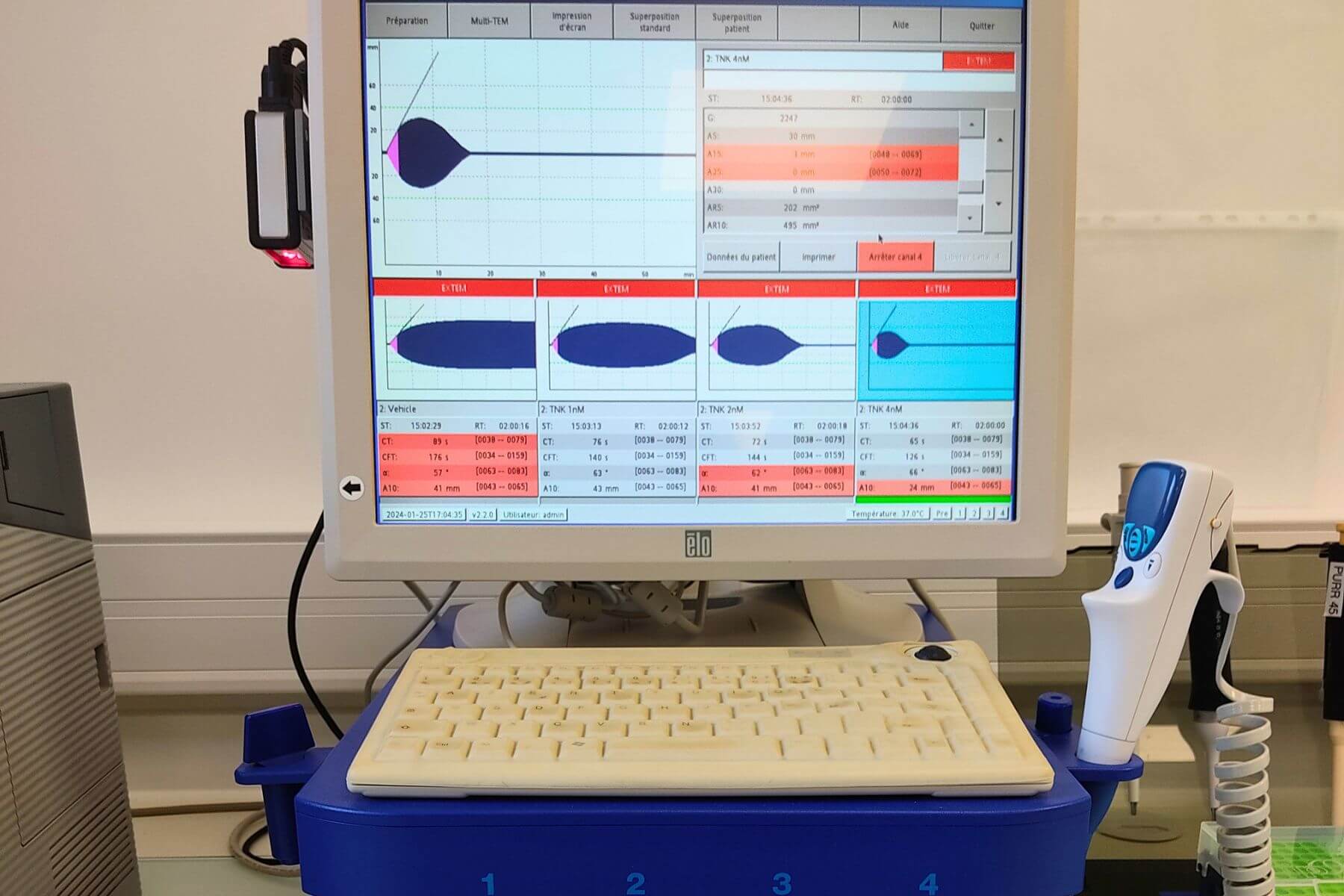
    ROTEM assay

    This assay also allows investigation of compound interactions when combined with reference fibrinolytics (Alteplase, Tenecteplase).

    The ROTEM assay, performed on fresh human whole blood, measures the viscoelastic properties of the clot throughout its formation and subsequent lysis.

    A wide range of parameters can be extracted from the thromboelastogram, including the clotting time, the maximum clot firmness, and the 50% clot lysis time (LT50). This low-throughput assay offers an extensive and customisable set of hemostatic conditions for evaluating anticoagulant or thrombolytic compounds, including extrinsic or intrinsic activation pathways, as well as the addition of coagulation factors or modulators.

  • Glutamate-induced toxicity: organ-on-chip

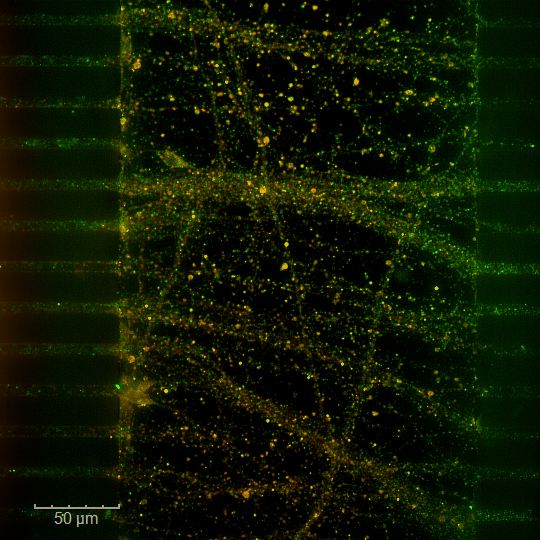
    Glutamate-induced toxicity: organ-on-chip

    Excitotoxicity is a key pathophysiological mechanism in ischemic stroke and contributes significantly to the consolidation of brain injury at sites distant from the ischemic core.

    Our brain‑on‑chip model is designed to reproduce secondary excitotoxicity by delivering glutamate specifically into a synaptic chamber located at the interface between two spatially separated neuronal populations (i.e. each maintained in its own microphysiological environments).

    Our microfluidic platform, combined with high‑content imaging, enables medium‑throughput screening of the effects of your compound on an isolated synapse, physically distant from the soma and exposed to excessive glutamate.

  • MCA occlusion by FeCl₃ or AlCl₃ application

    This preclinical ischemic stroke model is induced by the formation of a platelet‑rich clot that is resistant to standard fibrinolytics (Alteplase, Tenecteplase) but responsive to other thrombolytic agents such as N‑acetylcysteine. By reflecting the subpopulation of patients who fail to respond to standard‑of‑care treatments, this translational model is a powerful tool for assessing the efficacy and superiority of your candidates, combination therapies, and pharmacological interactions.

    Validated model available in mice.

  • ROTEM assay

    ROTEM assay

    The ROTEM assay, performed on fresh human whole blood, measures the viscoelastic properties of the clot throughout its formation and subsequent lysis. A wide range of parameters can be extracted from the thromboelastogram, including the clotting time, the maximum clot firmness, and the 50% clot lysis time (LT50). This low-throughput assay offers an extensive and customisable set of hemostatic conditions for evaluating anticoagulant or thrombolytic compounds, including extrinsic or intrinsic activation pathways, as well as the addition of coagulation factors or modulators.

    This assay also allows investigation of compound interactions when combined with reference fibrinolytics (Alteplase, Tenecteplase).

  • MCA occlusion by thrombin injection in diabetic animals

    This thrombotic model reproduces a highrisk clinical population, as diabetes increases lesion volumes as well as the occurrence and severity of hemorrhagic transformations. In this exclusive model, Alteplase loses its efficacy and can worsen ischemic damage. Fully aligned with STAIR recommendations, this comorbidityinclusive model is a key translational tool for evaluating the efficacy of your candidate alone or in combination, assessing associated hemorrhagic risk, and investigating pharmacological interactions.

    Validated model available in mice.

  • Glutamate uptake by astrocytes

    Astrocytes play a central role in maintaining synaptic homeostasis and preventing excitotoxicity by clearing excess extracellular glutamate. This protective function becomes impaired in reactive astrocytes during the post-ischemic inflammatory phase.

    Our astrogliosis model enables the screening of your compounds targeting glutamate uptake in human astrocytes (iPSC) activated with a cytokines cocktail. Activation of the NFκB pathway is also available as a routine readout through our high-content imaging platform.

  • Tail bleeding assay

    The tail bleeding test is a goldstandard assay used to evaluate hemostasis and platelet function in vivo.

    This model is sensitive to anticoagulant and fibrinolytic treatments commonly administered in the clinic, such as heparin, direct oral anticoagulants, or Alteplase. This model supports the evaluation of candidate efficacy across multiple drug classes, such as anticoagulants, procoagulants, and antiplatelet agents.

    Validated model available in mice

Previous Page
1 2 3
Next Page
Logo
Home Our services Working with us Company
News Career Contact
FrançaisEnglish
ETAP SA (Head office)
13, rue du Bois de la Champelle
54500 Vandœuvre-lès-Nancy
FRANCE
Phone no.:
+33 (0)383 444 635
Contact us →
Subscribe to our newsletter and get all our latest news.
GET OUR NEWSLETTERS
LinkedIn
Legal Notice · Design by Thibaut Marquis · Dev by Yann Sainty · Capital ETAP SA 45737 €
ETAP-LAB
Manage consent
To provide the best experiences, we use technologies such as cookies to store and/or access device information. Consenting to these technologies will allow us to process data such as browsing behavior or unique IDs on this site. Not consenting or withdrawing consent may adversely affect certain features and functions.
Functional Always active
The technical storage or access is strictly necessary for the legitimate interest purpose of enabling the use of a specific service explicitly requested by the subscriber or user, or solely for the purpose of carrying out the transmission of a communication over an electronic communications network.
Preferences
The technical storage or access is necessary for the legitimate interest purpose of storing preferences that are not requested by the subscriber or user.
Statistics
The technical storage or access that is used exclusively for statistical purposes. The technical storage or access that is used exclusively for anonymous statistical purposes. In the absence of a subpoena, voluntary compliance from your Internet Service Provider, or additional records from a third party, the information stored or retrieved for this sole purpose cannot generally be used to identify you.
Marketing
The technical storage or access is required to create user profiles in order to send advertising, or to track the user on a website or across several websites for similar marketing purposes.
  • Manage options
  • Manage services
  • Manage {vendor_count} vendors
  • Read more about these purposes
View preferences
  • {title}
  • {title}
  • {title}