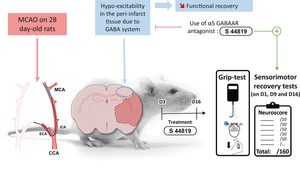
Consult this publication with Institut Servier – Post-acute delivery of α5-GABAA antagonist, S 44819, improves functional recovery in juvenile rats following stroke – in which in vivo studies were conducted on our original model of transient ischemic stroke, and demonstrating that targeting α5-GABAA receptors improves neurological recovery after stroke in juvenile rats. Published in Experimental Neurology (2021).
Keywords: Animal model; Behavioural tests; GABA; Recovery; Stroke.
Read the full article here: Link of this publication to Pubmed and https://doi.org/10.1016/j.expneurol.2021.113881
Authors: Florent Lebrun a b, Nicolas Violle a, Annelise Letourneur a, Christophe Muller a, Nicolas Fischer a, Anthony Levilly c, Cyrille Orset b c, Aurore Sors d, Denis Vivien b e
Affiliates:
- a ETAP-Lab, STROK@LLIANCE, 13 Rue du Bois de la Champelle, 54500 Vandoeuvre-les-Nancy, France
- b Normandie Univ, UNICAEN, INSERM, GIP Cyceron, Institut Blood and Brain @Caen-Normandie (BB@C), UMR-S U1237, Physiopathology and Imaging of Neurological Disorders (PhIND), Caen, France
- c ESRP (European Stroke Research Platform), Centre Universitaire de Ressources Biologiques (CURB), Université Caen Basse Normandie, Caen, France
- d Institut de Recherches Internationales Servier, Suresnes, France
- e Department of Clinical Research, CHU Caen-Normandie, Caen, France
Highlights
- The model of ischemia-reperfusion on adult rodent is transposable on 28 day-old rats
- α5-GABAAR antagonist S 44819 improves middle-term neurological recovery after stroke in juvenile rats
- As in adult rodents, GABAergic system plays a key role in physiopathology of stroke in juvenile rodents
Abstract:
Background and Objective
Evaluating α5-GABAA Receptor Antagonism After Juvenile Stroke
Hypo-excitability was reported in the peri-infarct tissue following stroke, an effect counteracted by a blockage of α5-GABAA receptors in adult rodents. Our present study aims to evaluate the effect of a selective α5-GABAA receptor antagonist, S 44819, in stroke in juvenile animals.
Experimental Model and Treatment Protocol
Development of a Juvenile Rat Model of Ischemic Stroke
We have set up and characterized an original model of transient ischemic stroke in 28 day-old Sprague-Dawley rats (45-min occlusion of the middle cerebral artery by intraluminal suture). In this model, S 44819 (1, 3 and 10 mg/kg, b.i.d) was orally administered from day 3 to day 16 after stroke onset. Sensorimotor recovery was assessed on day 1, day 9 and day 16 after stroke onset.
Neurological Recovery Outcomes
S 44819 Improves Sensorimotor Recovery
Results show that rats treated with S 44819 at the doses of 3 and 10 mg/kg displayed a significant improvement of the neurological deficits (neuroscore) on day 9 and day 16, when compared with animals treated with vehicle. Grip-test data analysis reveals that rats treated with S 44819 at the dose of 3 mg/kg displayed a better recovery on day 9 and day 16.
Conclusion
Targeting α5-GABAA Receptors Enhances Post-Stroke Recovery
These results are in agreement with those previously observed in adult rats, demonstrating that targeting α5-GABAA receptors improves neurological recovery after stroke in juvenile rats.
Graphical abstract
Graphical description of preclinical stroke model of MCAO and sensorimotor recovery tests