



Discover the poster dealing with A Translational Multi Model Platform for Preclinical Evaluation of Thrombolytics in Acute Ischemic Stroke, presented by Annelise Letourneur, STROK@LLIANCE team, at the Neuroscience congress (SfN) in San Diego (USA) in November 2025. The development of new thrombolytic treatments for ischemic stroke continues to face significant challenges in translating findings from preclinical studies to clinical efficacy. To improve the predictive value of preclinical evaluations, we have developed an innovative translational platform that combines several complementary experimental models of ischemic stroke, from in vitro evaluation to in vivo evaluation and safety. This approach allows us to analyze the efficacy, mechanisms of action, and safety of new therapeutic candidates under conditions that closely mimic clinical reality, particularly in patients with comorbidities. The poster presents the platforms, exemplified in 2 models through the evaluation of Microlyse®*, a von Willebrand factor–targeted thrombolytic agent that activates plasminogen independently of fibrin. Preclinical studies conducted on the drug candidate was presented with TargED* kind permission.
Significant milestones since the poster presentation:
- Microlyse®, a new thrombolytic agent developed by TargED, currently in clinical development.
Keywords: Thrombolytics, thrombolytic therapy, microlyse, drug development, Acute Ischemic Stroke, ischemic stroke, preclinical stroke models
Authors: *A. LETOURNEUR 1, F. LEBRUN 1, H. LEBAS 1, M. BAGUENEAU 1, F. STROKALLIANCE 1, E. CLERGUE 1, N. VIOLLE 2, D. VIVIEN 3;
Affiliated:
- 1. ETAP-Lab, CAEN, France;
- 2. Neurol., ETAP-Lab, Vandoeuvre-lès-Nancy, France;
- 3. INSERM U1237 – Phind, CAEN, France
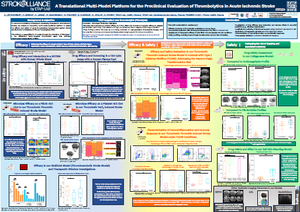
Abstract:
Objective: Building a Predictive Preclinical Platform for Stroke Drug Development
We established a translational preclinical platform using complementary rodent models of ischemic stroke to assess new thrombolytic candidates, with rt-PA or tenecteplase (TNK) as clinical benchmarks. We then applied this workflow to evaluate Microlyse, a novel thrombolytic agent.
Background:
Overcoming Translational Challenges in Ischemic Stroke Research
Despite decades of research, drug development for ischemic stroke has been hindered by translational issues, leading to clinical failures. We report a series of studies aiming to create a robust and versatile workflow of innovative rodent models enabling precise investigation of drug efficacy, mechanism of action, interactions with gold-standard fibrinolytics, and risks of hemorrhagic transformation (HT) and cerebral bleeding.
Methods: Multi-Model Preclinical Stroke Platform and Advanced Imaging Workflow
We developed a multi-model translational platform including:
• Two innovative and complementary mouse models of MCA occlusion inducing fibrin- or platelet-rich clots with differential responses to thrombolytics
• Inclusion of clinically relevant comorbidities (diabetes, hypertension)
• Translational and advanced imaging (laser speckle, MRI) to assess recanalization, reperfusion, infarct volume, HT, BBB disruption, and endothelial activation
• A novel neuroscore to monitor functional recovery over 5 weeks in rats
• A refined collagenase-induced ICH model to assess bleeding risks
• rt-PA or TNK used as reference comparators
Results: Microlyse Demonstrates Efficacy Across Multiple Experimental Stroke Models
Alteplase improved recanalization and reduced infarct size in fibrin-rich clots within a narrow time window. Like Alteplase, Microlyse reduced lesion volume and improved reperfusion. Platelet-rich clots showed resistance to rt-PA, mimicking poor responders. In this model, Microlyse—unlike Alteplase—reduced lesion volume, showing superior efficacy.
In rats, both rt-PA and Microlyse improved neuroscore, correlating with lesion volume at 5 weeks.
In mice, comorbidities increased lesion size, HT, and neuroinflammation, while impairing fibrinolysis and enhancing rt-PA-related HT. In diabetic mice, Alteplase showed no benefit on lesion volume, while Microlyse remained effective, indicating broader applicability.
In the collagenase model, TNK and some anticoagulants significantly increased bleeding.
Conclusion: A Translational Tool for Accelerating Stroke Therapy Development
This multi-model platform offers a robust, translationally relevant tool for evaluating novel stroke therapies, enabling:
• Efficacy comparison with rt-PA or TNK
• Simulation of high-risk or non-responder subpopulations
• Early detection of safety or interaction risks
Integrated into a comprehensive workflow, these models have already supported development of several agents, including Microlyse, now advancing to clinical evaluation.
